 Electrical
Table of Contents
Every year the first cold snap brings the same calls. The space heater came out of the closet, got plugged in by the bed or under the desk, and an hour later the breaker tripped. Or it did not trip, and somebody noticed the plug was too hot to touch and the face of the outlet had turned brown.
Neither of those is bad luck. A space heater is the biggest thing most people ever plug into an ordinary wall outlet, and a lot of the outlets in Bucks County houses were never meant to carry it. Here is what is actually going on, how to tell whether a given outlet can handle one, and what to do about the room that is always cold.
The Math: 1,500 Watts Is a Lot for One Outlet
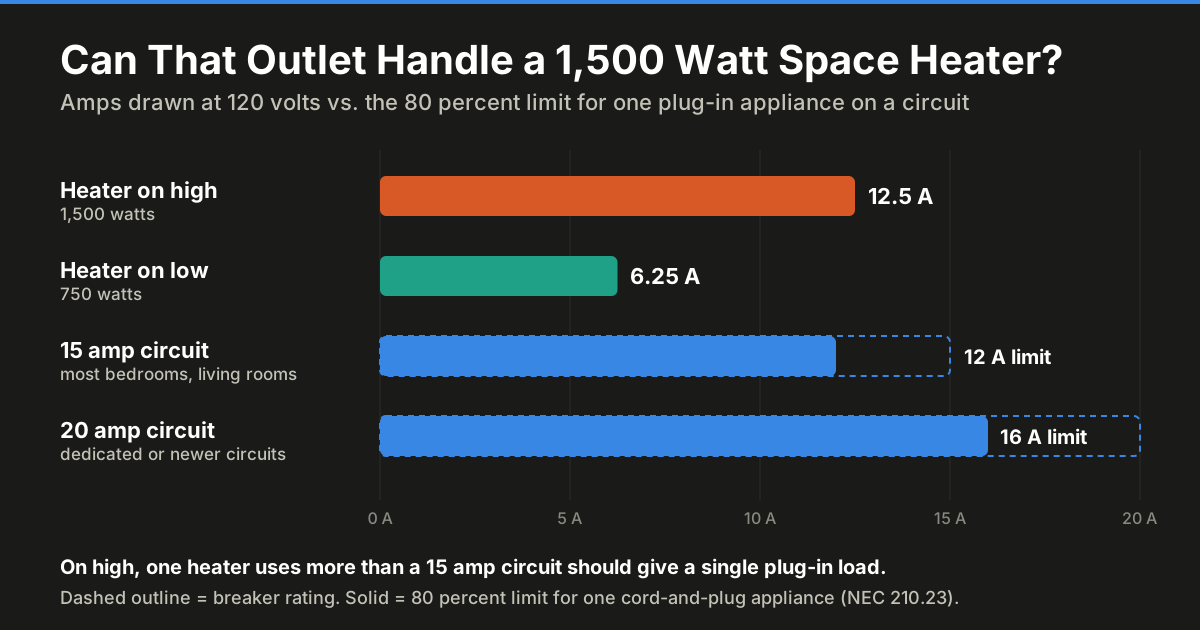
Almost every plug-in space heater sold in the US tops out at 1,500 watts. At 120 volts, that is 12.5 amps.
Most bedroom, living room, and office outlets in a house are on 15 amp circuits. The electrical code (NEC 210.23, which Pennsylvania enforces through the 2017 edition) says any single cord-and-plug appliance that is not fastened in place should not draw more than 80 percent of the circuit rating. On a 15 amp circuit, that is 12 amps.
So a space heater on high, all by itself, is already over what a 15 amp circuit should be giving one plug-in load. And it is never by itself. That circuit is also running the lamps, the TV, the phone chargers, and very often the outlets in the next room too.
On a 20 amp circuit, the 80 percent number is 16 amps, and the heater fits with a little room to spare. That is the circuit you want a heater on.
Why the Breaker Trips (and Why That Is the Good Outcome)
A standard breaker trips on heat. Run 14 or 15 amps through a 15 amp breaker for a while and it gets warm enough to open. That is why the heater runs fine for 40 minutes and then everything goes dark: the heater plus whatever else is on the circuit crept over the line.
When a breaker trips, it did its job. It protected the wire in your walls. The fix is not a bigger breaker. Putting a 20 amp breaker on wire sized for 15 amps removes the only thing protecting that wire, and it is one of the code violations we find most often in older homes. We covered the other common causes in why breakers trip and what an overloaded circuit is.
The Worse Problem: The Outlet That Gets Hot but Never Trips
A hot plug or a discolored outlet is the more dangerous situation, because the breaker cannot see it. The breaker watches current. It has no idea that one connection in one box is overheating.
Here is how that happens. A 12.5 amp load running for hours is hard on any connection, and the weak points in an older house are predictable:
- Worn receptacles. After years of plugs going in and out, the contacts inside lose their grip. A loose contact has resistance, and resistance under a heavy load makes heat.
- Backstabbed wiring. A lot of outlets were wired by pushing the wire into a hole in the back instead of wrapping it around the screw. Those push-in connections are fine for a lamp and a poor match for a heater running all evening.
- Loose screw terminals and old splices. These loosen over decades of heating and cooling.
- Extension cords and power strips. A light-duty cord is not built to carry a heater’s current for hours. Most heater manufacturers, and fire safety agencies, say to plug space heaters directly into the wall, not into a cord or a strip.
If a plug is too hot to hold, the cover plate is warm, the outlet face is brown or melted, or you smell something like hot plastic, stop using that outlet and have it looked at. That smell is the subject of a whole post: why you should never ignore a burning smell from an outlet.
How to Tell If an Outlet Can Handle a Heater
You can do most of this yourself in ten minutes:
- Find the circuit. With the heater off, flip breakers until the outlet goes dead. Then walk around and see what else went dead with it. If it took out half the second floor, that is not a heater circuit.
- Look at the breaker. The number on the handle is the rating. 15 means 15 amps. A 20 is better, as long as it is on the right size wire, which is something an electrician should confirm.
- Check the outlet. A receptacle that lets the plug sag or fall out on its own is worn. Replace it before the heater goes on it.
- Plug straight in. No extension cord, no power strip, no cube tap.
- Feel the plug after 30 minutes. Warm is normal. Hot is not.
Running the heater on its low setting (usually 750 to 900 watts) cuts the current roughly in half and solves the problem on a lot of circuits. If the room stays comfortable on low, use low.
What It Actually Costs to Run
People think of a space heater as the cheap way to heat one room. Sometimes it is. Often it is not.
A 1,500 watt heater on high uses 1.5 kilowatt-hours every hour. At roughly 22 cents per kilowatt-hour all in on a typical PECO residential bill (that is the 11.76 cent price to compare through November 30 plus PECO’s distribution charge), that works out to about:
- 33 cents an hour on high
- About $2.60 a day at 8 hours a day
- About $79 a month at 8 hours a day, every day
That is one heater. Two of them running evenings in two rooms is the most common answer we give to “why did my January bill jump.” It is also why, in our post on why your PECO bill keeps rising, the space heater made the short list of loads that move a bill. The price to compare resets again on December 1. We are not going to guess the number, but it will not make the heater cheaper to run.
Any plug-in resistance heater turns one kilowatt-hour into one kilowatt-hour of heat. There is no “efficient” 1,500 watt heater that puts out more heat for the same power, whatever the box says. A heat pump, by comparison, typically moves two to three times as much heat into the room for each kilowatt-hour it uses.
Fire Safety Basics That Actually Matter
National Fire Protection Association research has found the same thing for years: space heaters are involved in a minority of home heating fires but the large majority of the deaths from them, and roughly half of all home heating fires happen in December, January, and February. Most of those fires come down to the heater being too close to something that burns. The rules are short:
- Keep it at least 3 feet from bedding, curtains, furniture, clothes, and holiday decorations.
- Buy a heater with tip-over and overheat shutoff and a safety listing mark (UL, ETL, or CSA) on it.
- Turn it off when you leave the room or go to sleep.
- Keep it on the floor on a hard, level surface, not on a rug or a chair.
- Make sure the smoke alarms on that floor actually work.
When a Cold Room Needs a Circuit, Not a Heater
If you are running a space heater in the same room every day of the winter, that room is telling you something. The bonus room over the garage, the finished basement, the sunroom, the addition that was tacked onto the end of the house in 1985: these are the rooms we get called about.
A few ways we fix it, depending on the house:
- A dedicated 20 amp outlet where the heater lives, so it is not sharing with the rest of the floor. This is the quick fix, and our post on dedicated circuits explains why most houses need more of them than they have.
- A hardwired electric heater (baseboard, wall, or toe-kick unit) on its own 240 volt circuit with a real thermostat. No cord, no plug, no outlet to overheat.
- A ductless mini-split for a room that needs heat and cooling. It uses far less power per unit of heat than any resistance heater. We handle the electrical side.
Which one makes sense depends on how much room you have in the panel, how the room is wired now, and how you use it. That takes a look at the house, not a guess over the phone.
The Short Version
- A 1,500 watt heater draws 12.5 amps, which is more than a 15 amp circuit should give any one plug-in appliance.
- A tripping breaker is protection doing its job. Never “fix” it with a bigger breaker.
- A hot plug or a brown outlet is the real danger. Stop using it.
- Plug straight into the wall, use low when you can, and keep 3 feet of clearance.
- At about 33 cents an hour on high, a heater you run every evening can add $70 or more to a monthly bill.
If you have a room that only gets warm with a space heater, or an outlet that is already showing heat damage, contact Graff’s Electric. We serve homes across Bucks and Montgomery County, and members of our Electric Care plan get the outlets and panel checked as part of the annual inspection. Better to find the worn outlet in October than in January.
Sponsored
Need a Licensed Electrician?
Serving Bucks & Montgomery County. Free estimates on all projects.
Get Your Free EstimateNeed Help With This?
Graff's Electric & IT Solutions is here to help with all your electrical and technology needs in Bucks & Montgomery County.