 Generators
Table of Contents
The third hour of an outage, when the house is getting cold and the sump pump has stopped cycling, is when most Bucks County homeowners start pricing generators. The question is rarely “do I need backup power.” It is “do I need the standby unit wired into the panel, or will the portable in the garage cover me?”
Both can keep your lights on. They are not the same thing. The right pick depends on how long your outages usually last, what you actually need to run, and how much work you want to do outside at 2 a.m. in sleet.
Why We Are Talking About This in October
NOAA’s winter outlook, released October 16, is built around a very strong El Nino. For the East Coast it leans wetter than normal from December through February, and milder than normal across much of the East. Milder and wetter does not mean quiet around here. Storms running up the coast with temperatures hovering right around freezing are exactly how we get heavy wet snow and freezing rain, and that is what brings limbs down on lines.
This summer already showed how thin the margin is: the Fourth of July storms left more than 18,000 homes dark on July 5, and a week later microbursts knocked out 34,000 customers around Philadelphia. A winter outage is a different animal, because without power most gas furnaces cannot run either. The blower, the igniter, and the controls are all electric.
What Each One Actually Is
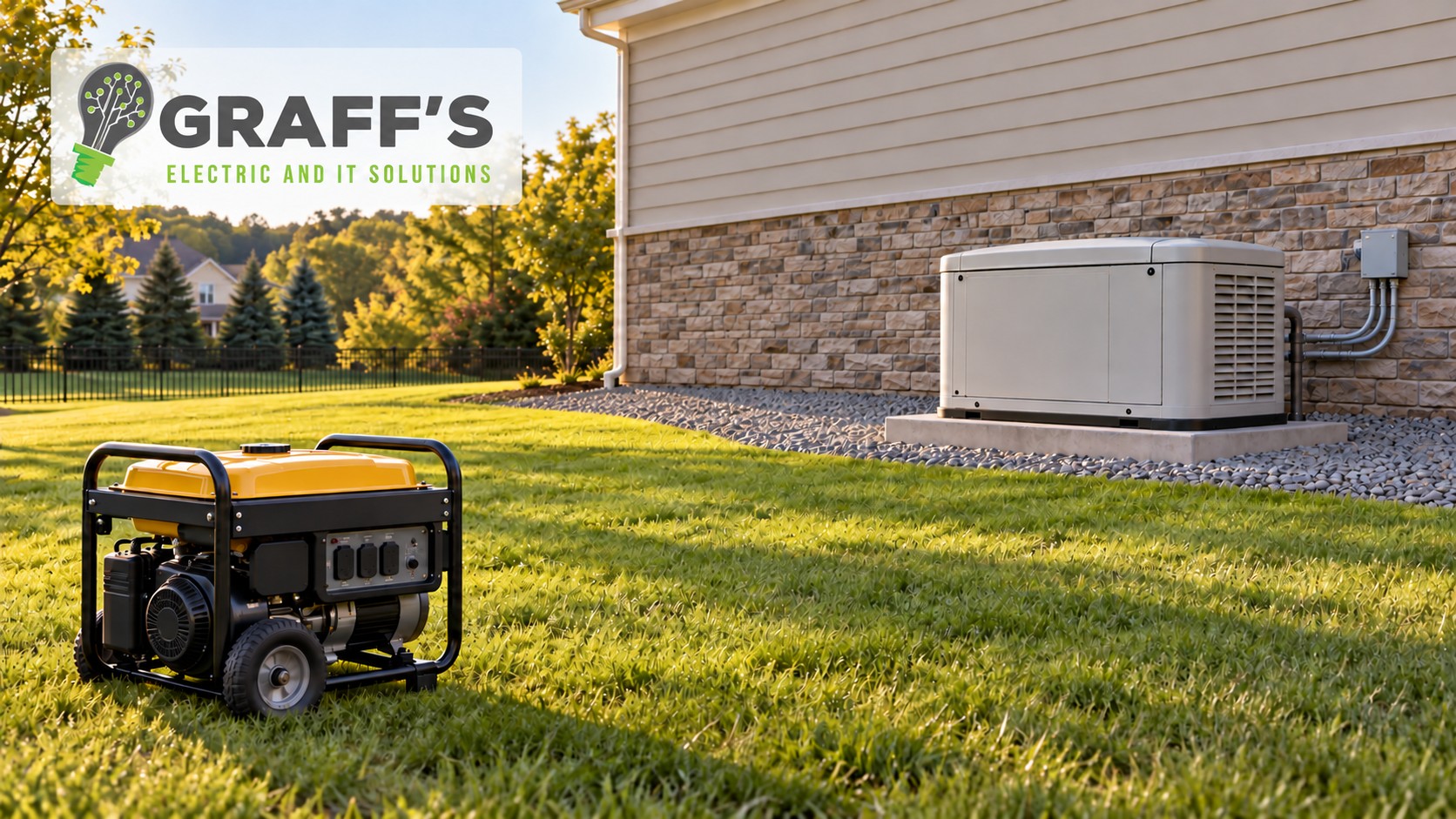
A whole house standby generator is a permanently installed unit, usually 14kW to 26kW for a typical 2,000 to 3,500 square foot home, that sits on a pad outside near the gas meter or propane tank. It is wired to your panel through an automatic transfer switch (ATS). When utility power drops, the transfer switch senses it, starts the generator, and moves the house over to generator power, usually within 10 to 30 seconds. You do nothing. Most run on natural gas or propane and run a weekly self-test.
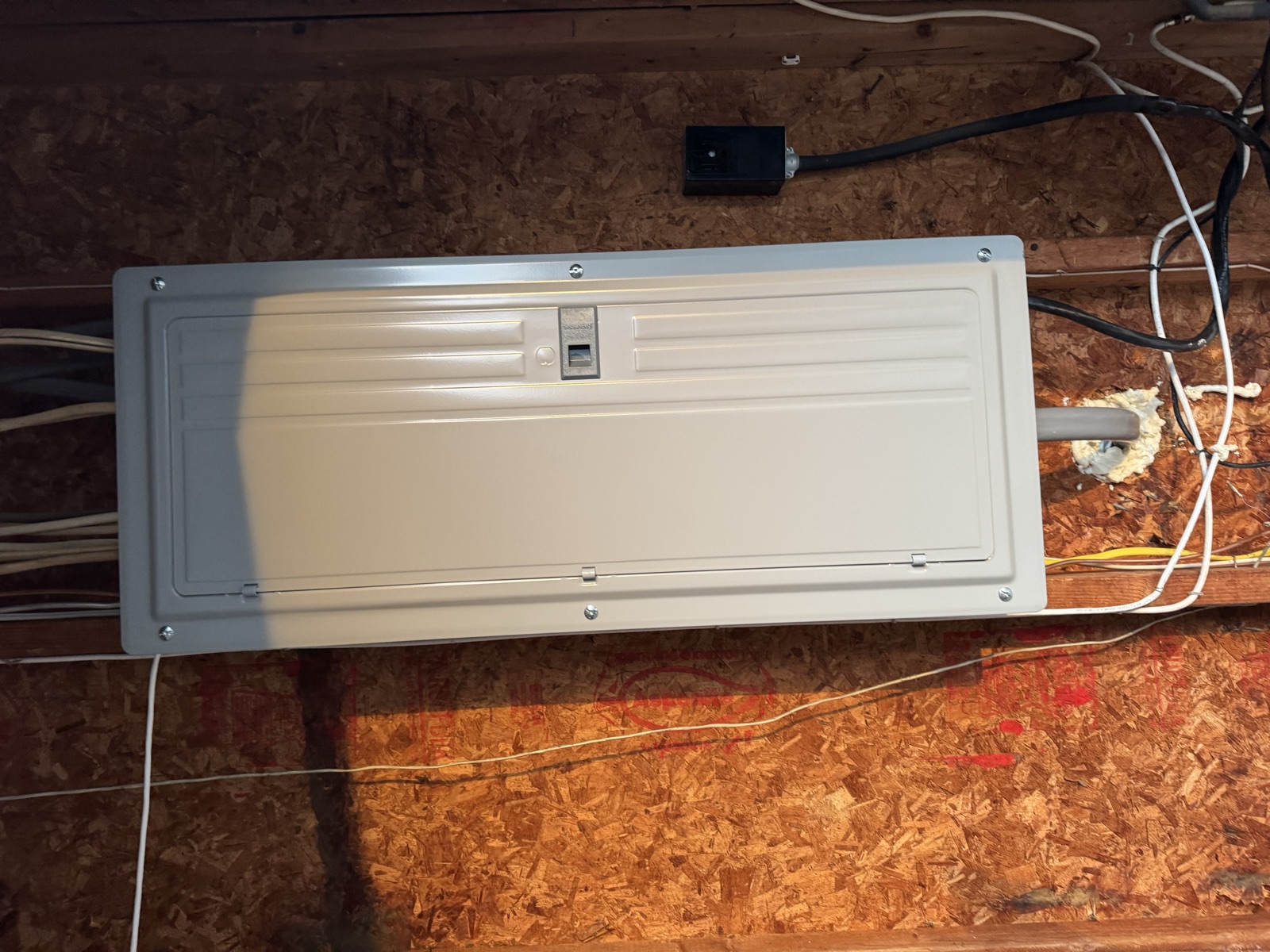
A portable generator is what most people picture: an engine on wheels with outlets on the front. Output runs from about 3,500 watts on a basic model up to the 12,000 to 17,500 watt “home backup” portables. You roll it outside, fuel it with gasoline (or propane on dual-fuel units), start it yourself, and either run cords to what you need or feed the house through a proper connection. That proper connection is a power inlet box on the outside wall plus a manual transfer switch or a listed interlock kit at the panel. Done that way, a portable can run hardwired loads like the furnace and the well pump with no cords through the windows.
Wattage: What You Are Actually Trying to Power
The number that matters is not the big number on the side of the generator. It is the starting (surge) wattage of the motors in your house, because a motor pulls several times its running watts for a second or two when it kicks on.
A typical outage load list in a Bucks County house looks something like this:
- Refrigerator: about 1,200W to start, 200W running
- Chest freezer: about 1,200W to start, 200W running
- Sump pump: about 2,100W to start, 800W running
- Gas furnace blower and controls: about 1,600W to start, 600W running
- Well pump, if you are on a well: 3,000W or more to start, about 1,000W running
- Modem, router, a few lights, phone chargers: a couple hundred watts
That is roughly 2,800W to 3,800W of steady load, with starting spikes that can push past 6,000W if the well pump and the sump kick on at the same moment. These are typical figures, not your house; nameplates and motor sizes vary.
So, in round numbers: a 3,500W portable will keep the fridge and a couple of lamps going and not much else. A 7,500W to 9,500W portable covers most of the list above plus the microwave, but not central air. A 14kW to 22kW standby is where you can keep central air, an electric range, and most or all of the panel live without juggling.
Cost: Typical Ranges, Not Quotes
Every install is different, so treat these as the ranges we typically see for residential work in Bucks County, not a price for your house. The real number comes after a site visit, because gas line length, panel condition, and where the unit can legally sit change the job a lot.
- 14kW air-cooled natural gas standby with a 200A automatic transfer switch: typically $7,500 to $10,500 installed
- 22kW air-cooled standby with a 200A ATS: typically $10,500 to $14,500 installed
- 26kW and up, for larger homes with heat pumps or EV charging: typically $15,500 to $22,000 installed
Those ranges assume the concrete or composite pad, gas tie-in with the meter a reasonable distance away, the ATS, panel work, permit, and inspection. Propane-fed installs add the tank, either a lease or a 250 to 500 gallon buried tank, which can add a few thousand dollars on top.
Portables are a different scale. A solid 9,500W dual-fuel portable from a name brand commonly runs $1,100 to $1,800 at retail. Add an inlet box and a manual transfer switch or interlock kit installed by a licensed electrician, and most portable-fed setups land somewhere around $2,000 to $3,500 all in. Again, typical, subject to what we find at your panel.
Run Time and Fuel: The Part People Underestimate
A natural gas standby has no practical run-time limit. As long as the gas keeps flowing, it keeps running. A propane standby is limited by the tank: a 500 gallon tank filled to the usual 80 percent can run a 22kW unit at half load for roughly a week. Check your actual fill level going into winter, not in the middle of an outage.
A 9,500W portable on gasoline at half load burns somewhere around three quarters of a gallon an hour. A 6 to 7 gallon tank gets you roughly 8 hours. For a three-day outage that means keeping 20 to 30 gallons of fresh, stabilized gas on hand and refueling a hot engine outside, in the dark, every 8 hours or so. On propane, a standard 20 pound grill tank lasts something like 4 to 6 hours at half load, so you either need a stack of full tanks or a hookup to a bigger tank.
A standby is something you can sleep through. A portable is a part-time job for as long as the outage lasts.
The Safety Part We Will Not Skip
Two things every portable owner needs to hear, especially in winter.
Carbon monoxide. Run the generator outside, well away from the house. The CDC says at least 20 feet from doors, windows, and vents, and never in the garage, not even with the door open. Have working CO alarms on every level.
Backfeeding. Never plug a generator into a dryer outlet or any other receptacle with a double-male “suicide cord.” Without a transfer switch or interlock, that power flows back out onto the utility lines and can kill a lineman working what he thinks is a dead wire, and it can fry the generator when power comes back. An inlet box and a transfer switch or interlock make it impossible to have the utility and the generator connected at the same time. That is the whole point of them.
When the Portable Is the Right Answer
A portable makes sense if your outages are usually short, you do not have a sump pump or well pump that absolutely must run unattended, you have a safe outdoor spot to run it and store fuel, and you are fine being the one who keeps it going. A lot of Bucks County outages are storm-driven and come back within a day. For a family on public water with no flooding history, a 9,500W portable feeding the panel through an interlock covers the realistic scenarios without overspending.
A correctly sized portable plus a code-compliant panel setup and a permanent inlet box is real backup power, not a cheap compromise. It is the smaller tool for a smaller job.
When the Standby Is the Right Answer
Go standby if any of these are true:
- You have a well pump or a sump pump that has to run during a storm, no exceptions.
- You have a finished basement that will take on water within hours of the sump stopping.
- You work from home and cannot be down for a full day.
- Someone in the house depends on medical equipment.
- You travel in winter and the house needs to protect itself when no one is there to fuel anything.
The standby is also worth a hard look if a panel upgrade is already on your list, or if your panel has any of the problems in our outdated panel warning signs. Doing both at once means we are only in the panel once, and the transfer switch gets sized right the first time.
Sizing the Standby Without Overbuying
Do not add up every nameplate in the house; no house runs everything at once. Decide which loads truly have to stay on, then pick a unit that covers that list with room for motor starting. Modern transfer switches can also shed big loads like the AC or a water heater automatically when the generator is near its limit, which lets a smaller unit do more.
As a rough guide: a 2,400 square foot house with gas heat, public water, a 200A panel, and no need for central air during an outage is usually well served by about 14kW. Same house where the AC has to stay on, look at 22kW. Bigger homes, heat pumps, well systems, or an EV that has to charge during a long outage usually push you to 22kW to 26kW. Our whole-home generator sizing guide walks through the math in more detail.
What to Check Before You Buy Either One
- Get a load calculation. Our free residential load calculator lets you sanity-check whatever anyone proposes to you.
- Confirm the fuel supply. A 22kW unit on natural gas needs a gas meter and line that can actually deliver enough volume at full load. A marginal supply makes the generator struggle exactly when you need it most.
- Confirm the install will be permitted and inspected. Bucks County townships differ on where an outdoor generator can sit relative to windows, property lines, and neighbors. An uninspected install can come back to bite you when you sell.
The portable wins on cost. The standby wins on just about everything else.
If you want help figuring out which side of that line your house is on, reach out to Graff’s Electric. We work all over Bucks and Montgomery County, and the best time to sort this out is before the first ice storm, not during it.
Sponsored
Need a Licensed Electrician?
Serving Bucks & Montgomery County. Free estimates on all projects.
Get Your Free EstimateNeed Help With This?
Graff's Electric & IT Solutions is here to help with all your electrical and technology needs in Bucks & Montgomery County.