 Electrical
Table of Contents
The federal government never recalled Federal Pacific Stab-Lok panels. It never cleared them, either. Both halves of that sentence matter, and the internet tends to lose one of them. Some pages call these panels “recalled.” Others call the whole thing a myth. Neither is right.
Homeowners insurance gets the same treatment. Plenty of electrician websites say insurers are dropping homes over these panels, usually without naming an insurer. We sell panel replacements too, so you should weigh what we say the same way. Here is what we could actually find as of November 3, 2026: what is on record for Federal Pacific, Zinsco, and Challenger, what insurers have put in writing, what Pennsylvania’s rules say if your carrier brings it up, and what we could not confirm.
First, Find Out What You Have
You can usually answer this without any tools. Open the hinged door on the panel and read the label, which is often on the inside of the door. Do not remove the screwed-on cover behind the door. That part has live parts behind it and is a job for an electrician.
- Federal Pacific: look for “Federal Pacific,” “FPE,” or “Stab-Lok.” Ohio Mutual’s loss-prevention sheet points to the red company logo.
- Zinsco: look for “Zinsco,” “Sylvania,” “GTE-Sylvania,” or “Magnatrip.” Ohio Mutual points to a blue label logo. Multicolored breaker handles are a reason to look closer, not proof on their own.
- Challenger: the CPSC says to look for “Challenger” embossed on the front door handle, or a label on the back of the panel or door.
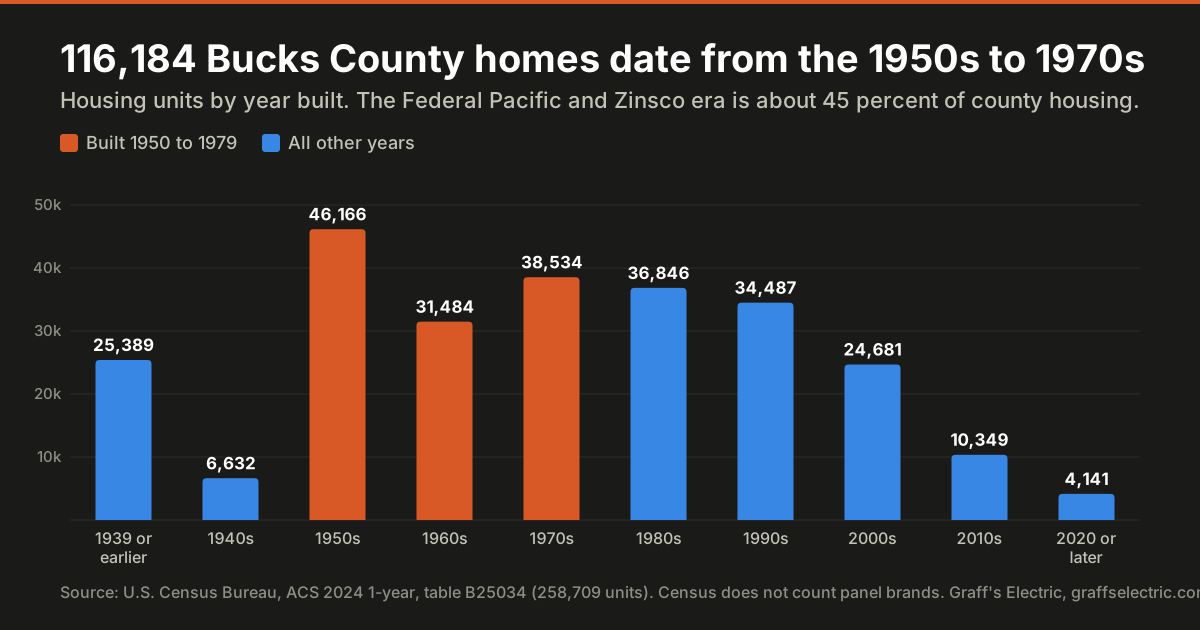
Age tells you whether it is worth looking. Insurer loss-control documents date these panels to roughly 1950 through the 1980s: AmTrust says Federal Pacific went into buildings from 1960 to 1985, and Ohio Mutual says Federal Pacific and Zinsco are frequently seen in construction from 1950 to 1990. The Census Bureau’s 2024 estimate puts 116,184 of Bucks County’s 258,709 housing units, about 45 percent, in the 1950s, 60s, and 70s, which is what the chart at the top of this post shows.
That number is a place to look, not a count of bad panels. The Census does not track panel brands, nobody publishes a Bucks County count, and many of those houses have been updated since. The label on your door is the only answer that counts.
Federal Pacific: The Strongest Record of the Three
The paper trail starts with the company itself. In June 1980, Reliance Electric, Federal Pacific’s parent company, told the Consumer Product Safety Commission that many FPE breakers did not fully meet Underwriters Laboratories requirements. The CPSC’s own testing then found the breakers “fail certain UL calibration test requirements,” but the agency said it could not tie those failures to a hazardous situation. Reliance argued the breakers were reliable at the overload levels that matter.
In March 1983 the CPSC closed the investigation, citing a limited budget and a staff estimate of several million dollars to get the data it needed. The agency revised its release in 2011 to spell out what that closure meant: it “closed the matter without making a determination as to the safety of FPE circuit breakers.” So when someone says the CPSC cleared these panels, that is wrong. When someone says the CPSC recalled them, that is also wrong.
Outside testing is where the alarming numbers come from. NBC 5 in Dallas reported in 2011 that a study by engineer Jesse Aronstein, who has been testing these breakers since the 1980s, found about one in four of nearly 1,500 Federal Pacific breakers failed to trip when overloaded. Other reports give other figures: AmTrust’s 2019 safety bulletin says testing from 1979 to 1983 found failures to trip in 14 to 74 percent of tests, and news coverage in 2019 used 51 percent. The spread reflects different tests and samples, so be wary of anyone quoting one number as the number. In 2019, U.S. Rep. Paul Tonko asked the CPSC to reopen the investigation. We found no record that it did.
There is also a court finding, and it is narrower than people assume. In a New Jersey class action, Yacout v. Federal Pacific Electric Company, the Superior Court found a violation of the state Consumer Fraud Act because the company “knowingly and purposefully distributed circuit breakers which were not tested to meet UL standards.” That is a finding about testing and labeling, not a ruling that every breaker will fail. The case settled in 2008 and the claim deadline is long past, so there is no payout waiting for you.
Zinsco: Real Concern, Thinner Record
We could not find a CPSC recall or investigation for Zinsco or Sylvania panels. Neither could a Texas home inspection company that went looking and published the result. As with Federal Pacific, that means the regulator never ruled on it. It does not mean the regulator approved it.
The concern is more about the connection than the trip setting. The breaker clamps onto a bus bar, and field reports going back decades describe that connection loosening, heating up, and in the worst cases melting or welding the breaker in place. Ohio Mutual’s bulletin adds that aluminum in these breakers oxidizes, which reduces its ability to carry current.
The published test data is small. Aronstein’s numbers, posted by InspectAPedia and current to March 2017, show 32 of 111 Zinsco-type breakers failing to trip within an hour at 135 percent of rated current, or 28.8 percent. Two of them did not trip at 200 percent. The same report says the typical failure rate for residential breakers is under 1 percent. That is a privately published test of 111 breakers, not a government finding, but Ohio Mutual still recommends full replacement of Zinsco panels by a licensed electrician.
Challenger: Mostly Confusion
Search for a “Challenger panel recall” and you will find people treating this as settled. The only CPSC action we could find is much narrower. In November 1988, Challenger Electrical Equipment offered free replacement of about 9,000 single-pole GFCI breakers, types HAGF-15 and HAGF-20, made between February 22 and April 29, 1988. A part could detach and stop the ground-fault protection from working. The CPSC said normal breaker function was not affected, and the company reported no shocks.
That is a recall of a few months of one breaker, not the panels. If you have a yellow test button on a Challenger GFCI breaker, have it checked; the CPSC notice has the identification details and says the company can no longer be reached at the original numbers.
Challenger ends up on the same lists because it also made Zinsco-pattern breakers, and insurer guidelines use terms like “Challenger-Zinsco.” Our take: a Challenger panel is not automatically the same problem as a Stab-Lok. It deserves a look at which breakers are in it and what condition it is in, and it still may matter to your carrier.
What Insurers Have Actually Put in Writing
The clearest written rules we found are from Florida, and they are old. We read both documents directly:
- Anchor’s Florida homeowners underwriting guide says risks with “Federal Pacific, Zinsco, Challenger, Stab-loc, & Sylvania panels are ineligible and require replacement.” The version we read is marked V20191216.
- Universal Property’s Florida binding guidelines, 10-24-18 edition, say “No Federal Pacific (includes Stab Lok), Zinsco, Sylvania-Zinsco, or Challenger-Zinsco Boxes.”
Those are real insurer documents that name the brands. They are also Florida guidelines from 2018 and 2019, and they say nothing about a Pennsylvania policy written today. Two other carriers have published safety guidance rather than eligibility rules: Ohio Mutual recommends full panel and breaker replacement, in a sheet aimed mainly at commercial buildings, and an AmTrust Florida bulletin from May 2019 says replacing the breakers alone is not recommended.
For Pennsylvania, we came up empty. We looked for a statement from the Pennsylvania Insurance Department, a published underwriting rule from a carrier writing here, and any data on policies non-renewed over panel brand, and we found none of those. That does not prove it never happens, since carriers set their own underwriting and most of it is not public. It means nobody can honestly tell you that Pennsylvania insurers are dropping these homes, or that yours does not care. The way to find out is to ask your agent, and to get the answer in writing, whether your policy or your carrier’s guidelines have any requirement about panel brand.
If Your Carrier Raises It: The Pennsylvania Rules
Pennsylvania does give homeowners some protection and a short deadline. The Insurance Department’s homeowners guide (revised 2017) addresses this directly: homeowners “do need to respond” when an insurer identifies a hazard or they could lose coverage, insurers have a right to manage their risks “within reason,” and the Department says it ensures requests are reasonable and that the homeowner gets sufficient time to make repairs.
Under 31 Pa. Code Chapter 59, which covers owner-occupied homes of up to four units on policies in force for 60 days or more, a cancellation or non-renewal notice has to:
- Take effect no sooner than 30 days after it is delivered or mailed.
- Give clear and complete reasons, and if the reason is a substantial change or increase in hazard, specify what the insurer relied on.
- Tell you that you can request a review, and that you may be eligible for the Pennsylvania FAIR Plan.
The deadline that catches people is the review window: 10 days from when you receive the notice. The Department’s guide says your statement must reach it within those 10 days, so do not let that letter sit on the counter.
Home buyers have less cushion. The same guide says a company has 60 days to underwrite a new application and can refuse or cancel coverage for various reasons during that period. If your inspection report names one of these panels, ask your agent before closing, not after. None of this is legal advice, and the Department’s Bureau of Consumer Services can answer questions about your specific notice.
Do You Have to Replace It?
Legally, we know of nothing that forces you to. There is no recall, and electrical code generally does not make you update existing equipment just because it is old. A lender or an insurer can add its own conditions, but that is a contract question, not a code question.
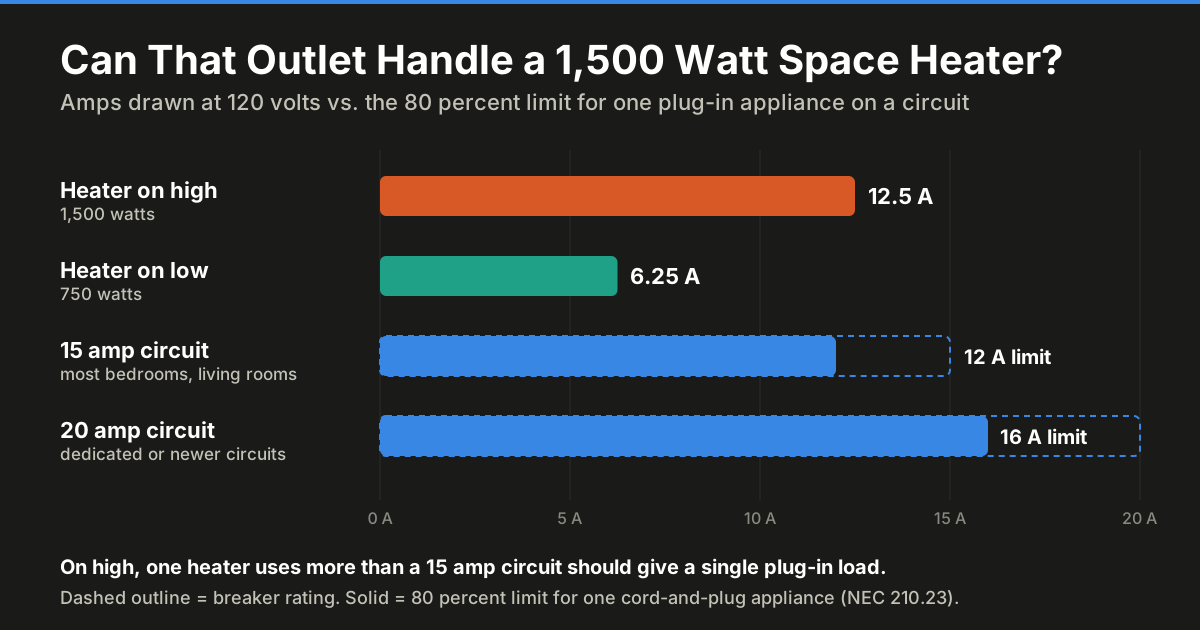
Our advice is still to replace a Federal Pacific or Zinsco panel on your schedule rather than wait for someone else’s. A breaker is the part of the system you can never test by using the house normally. It looks fine until the one time it has to work. The heating season is when that matters most, since a 1,500 watt space heater running for hours is a long, steady load on an old circuit. For a Challenger panel, have it evaluated first.
Swapping only the breakers is not a real fix. AmTrust’s bulletin says mixing brands of breakers and panels is outside the UL listing for the assembly and points to overheating concerns in the bus itself. Aronstein’s published tests of aftermarket replacement breakers for Stab-Lok panels reported failure rates in the 40 percent range across roughly 400 units.
If the panel has to stay for now, the CPSC’s general advice is sensible for any panel: know what is on each circuit, do not overload them, unplug anything acting up, and find out why a breaker tripped before you reset it. We would add one thing: do not hang a new EV charger, hot tub, or other big load on one of these panels.
What Replacement Looks Like in 2026
Our panel upgrade cost guide lists obsolete panel replacement, including Federal Pacific and Zinsco, at a typical range of $2,500 to $5,000 or more. Treat that as a general range and not a quote. The real number depends on the house and is subject to a site survey, especially if the job grows into a service upgrade. Our free load calculator will give you a head start on whether 100 amps still fits how you use the house. Why cheap panel replacements cost more covers what to look for in a low bid.
The new equipment has to meet today’s rules, and today’s rules changed this year. Pennsylvania’s Uniform Construction Code moved to the 2021 International Codes on January 1, 2026, which brings residential electrical work up to the 2020 National Electrical Code. Two items surprise people:
- Surge protection. NEC 230.67 (2020) calls for a surge protective device on dwelling services, and it applies when service equipment is replaced. Our surge protector page explains what it does.
- Outdoor emergency disconnect. NEC 230.85 (2020) and IRC E3601.8 call for one at one- and two-family homes, and Pennsylvania’s version limits the IRC rule to detached dwellings. Whether it applies depends on the scope of the job, so it should be settled when the work is scoped.
When it is done, keep the paid invoice and before-and-after photos of the panel. If a carrier or a buyer ever asks, that is what answers the question.
Where This Is Headed
Our prediction, and it is only a prediction: these brand names will come up more at sale and renewal, not less. Nobody is making the original equipment, the youngest of it is decades old, and the names are easy for an inspector or an underwriter to spot. A panel that nobody mentioned when you bought the house may get mentioned when you sell it. Replacing it now means doing it on your schedule, and not inside a 30-day notice or a closing date.
If you are not sure what is on your wall, tell us what the label says through our contact page, or read more about our panel services. If it turns out to be a newer panel, our Electric Care plan includes a yearly Panel Health Check with a written report and photos, so you will have it on paper either way. We serve homes across Bucks and Montgomery County, and we will tell you plainly which of these three you have and what we think it needs.
Sponsored
Need a Licensed Electrician?
Serving Bucks & Montgomery County. Free estimates on all projects.
Get Your Free EstimateNeed Help With This?
Graff's Electric & IT Solutions is here to help with all your electrical and technology needs in Bucks & Montgomery County.