 Electrical
 Table of Contents
Outdoor lighting is one of the few home improvements that simultaneously makes your property look better, feel safer, and function more practically - and it works around the clock. A well-designed outdoor lighting installation welcomes you home after dark, discourages opportunistic crime, extends the usable hours of a patio or driveway, and adds real dollar value to your property’s curb appeal. The challenge is that outdoor lighting covers a broad range of fixture types, purposes, and installation requirements, and the options have expanded dramatically with LED technology and smart controls. This guide helps homeowners throughout Bucks County and Montgomery County understand what they actually need and how to get the most out of a professional outdoor lighting installation.
Understanding the Three Types of Outdoor Lighting
Effective outdoor lighting design draws from three distinct categories, each serving a different purpose. Most homes benefit from a combination of all three, and understanding what each type does helps you make decisions that go beyond picking a fixture you like the look of.
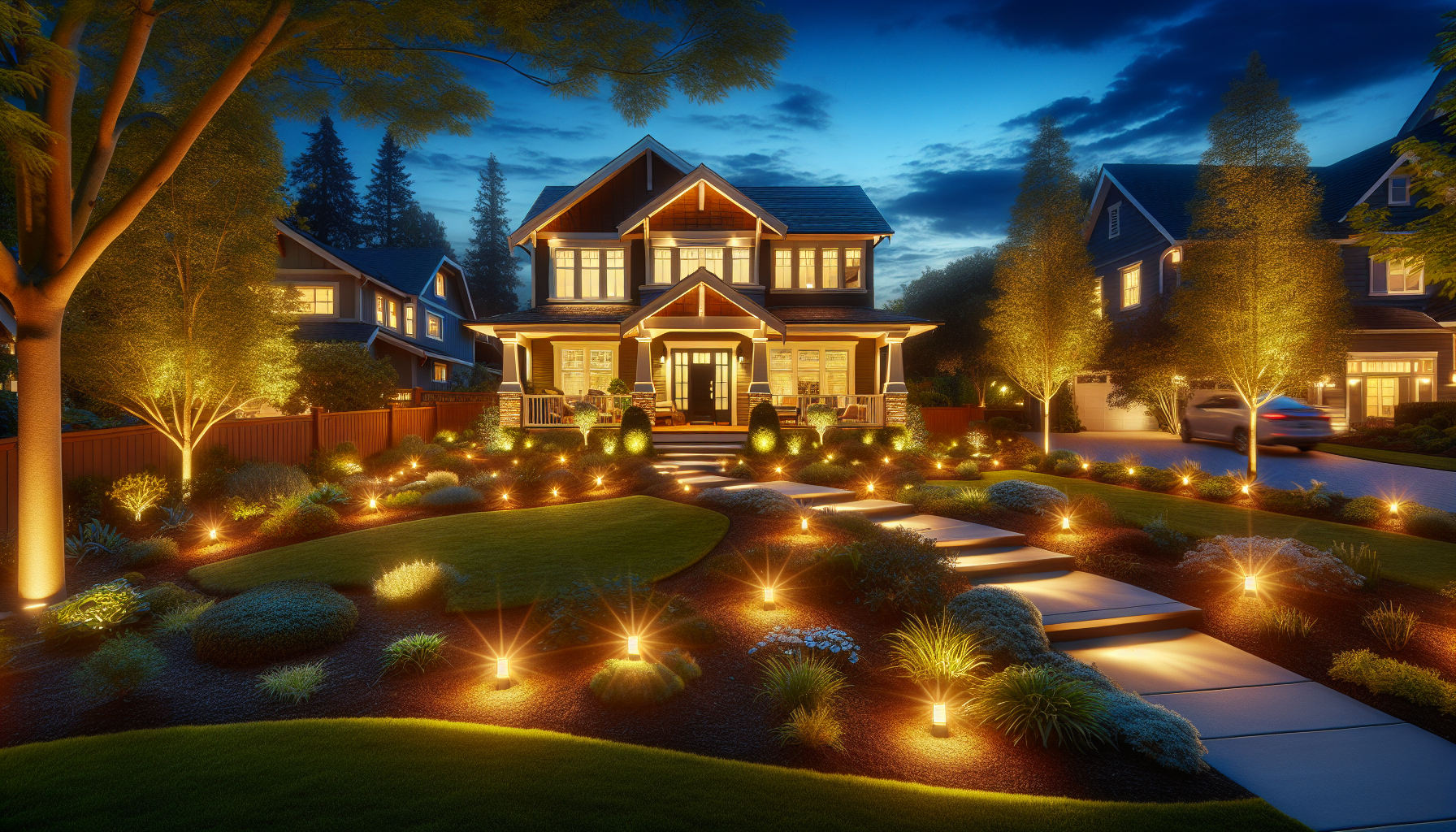
Landscape lighting is the decorative layer. It illuminates trees, garden beds, pathways, and architectural features with the goal of making your property look intentional and polished after dark. In-ground uplights that wash light up through the canopy of a mature tree, path lights that line a front walk, and wall wash fixtures that graze the texture of a stone facade all fall into this category. Landscape lighting transforms a property after dark in ways that daylight cannot replicate. A home in Doylestown or Newtown with mature trees and defined landscaping becomes something genuinely striking with the right uplighting.
Security lighting prioritizes function over aesthetics. The goal is visibility - eliminating the dark zones around a property where someone could move undetected. Motion-activated floodlights at garage corners, over side entry doors, and along the back of the house cover the areas that are most commonly exploited. Security lighting does not need to be aggressive or harsh to be effective. Modern LED security fixtures with adjustable sensitivity and warm color temperatures integrate into the overall look of a property far better than the old halogen floods they replace.
Accent lighting is the precision instrument of outdoor lighting. It draws attention to specific elements - a front door with architectural detail, a stone chimney, a flagpole, a garden sculpture. Accent fixtures are typically smaller and more directional than landscape lights, and they reward careful aiming. The difference between a fixture pointed correctly and one aimed a few inches off can be the difference between a striking visual effect and a blinding glare spot.
Most professional outdoor lighting installations for residential properties in Bucks County and Montgomery County blend all three types: a landscape lighting plan for the yard and pathways, targeted security coverage for vulnerable areas, and accent fixtures that give the front of the house a finished, curated look after dark.
Landscape vs. Security Lighting: Placement Strategy
Where you place fixtures matters as much as which fixtures you choose. Placement mistakes are common in DIY outdoor lighting projects and result in dark spots where you wanted light, overly bright areas that feel harsh, and fixtures that create glare without useful illumination.
For landscape lighting, the fundamental rule is to light the subject, not the fixture itself. A well-placed uplight hidden in a mulch bed at the base of a tree should be nearly invisible by day and produce a dramatic effect by night. Path lights should illuminate the walking surface and the transition from path to plantings, not create a runway of bright spots that draw the eye to the hardware rather than the landscape.
For security lighting, coverage is everything. Walk your property after dark with a flashlight and identify every area where someone could move without being visible from the street or from inside the house. Common blind spots include the space between the garage and the property line, the side yard between structures, any gate or fence opening, and the area around HVAC equipment or utility access points. Motion-activated floods positioned to cover these zones provide deterrence without running constantly through the night.
Overlap matters for security. A single flood covering a long side yard will have a shadow zone at the edge of its beam. Two fixtures with overlapping coverage eliminate that. Homes in Horsham, Hatfield, and Lansdale with larger lots or irregular lot shapes often need a more deliberate multi-fixture layout to achieve genuine coverage.
Height affects quality dramatically. Path lights installed at the correct height illuminate the path. Installed too low, they create glare at eye level when you are standing on the path. Security floods installed too high lose their effectiveness at ground level. Your electrician and lighting designer should account for mounting height as part of placement - not as an afterthought.
Smart Controls: Timer, Motion, and App-Based Options
The technology behind outdoor lighting controls has changed substantially in the past several years, and the options now available to homeowners in Bucks County and Montgomery County are meaningfully better than what was standard a decade ago.
Timers are the simplest and most reliable control method. A programmable timer turns lights on at sunset and off at a set time - or at sunrise - without any input from you. Astronomical timers adjust automatically to the changing sunrise and sunset times throughout the year, so you do not have to update the schedule seasonally. For landscape lighting connected to a single low-voltage transformer, a timer built into the transformer handles everything.
Motion sensors are the standard control for security lighting. Modern motion-activated security lights allow you to set sensitivity, detection range, and the duration that the light stays on after motion stops. Dual-zone sensors can distinguish between a car pulling into the driveway and a person approaching the door, allowing different responses. Adjustable sensitivity reduces false triggers from trees moving in the wind - a common complaint about older-generation motion sensors.
Smart lighting controls integrate your outdoor fixtures into a broader smart home ecosystem. Wi-Fi or Z-Wave enabled transformers for low-voltage landscape lighting allow app-based scheduling, zone control, and dimming from a phone. Individual smart switches on line-voltage fixtures like porch lights and garage overhead lights can be controlled through the same app. Lutron, Kasa, and similar platforms support outdoor lighting fixtures and integrate with Alexa, Google Home, and Apple HomeKit. For homeowners who want a cohesive smart home setup, routing outdoor lighting control through the same system as interior lights is entirely practical.
Photocells are the simplest automatic control - a light-sensitive sensor that turns fixtures on at dusk and off at dawn. They are inexpensive, reliable, and require no scheduling or programming. For fixtures that should simply be on whenever it is dark outside, a photocell is often the right choice.
LED Outdoor Lighting: Why It Changed Everything
Ten years ago, specifying LED fixtures for outdoor lighting sometimes meant compromises in color quality or output. That is no longer true. Modern LED outdoor fixtures produce excellent light quality at a fraction of the energy consumption of halogen and incandescent predecessors, and they last dramatically longer in outdoor environments.
A standard halogen floodlight used for security or accent purposes draws 65 to 150 watts and lasts roughly 2,000 hours. An LED equivalent producing the same or better output draws 10 to 20 watts and is rated for 25,000 to 50,000 hours. For fixtures that run on timers from dusk to dawn, that translates to roughly 10 to 15 years of bulb life versus the halogen alternative that needed replacement every couple of years.
Color temperature makes a significant difference in how outdoor lighting looks and feels. Warm white (2700K to 3000K) is the standard for residential landscape and accent lighting - it reads as inviting and residential rather than institutional. Neutral white (4000K) works well for security floods where color accuracy matters less and output matters more. Cool white or daylight (5000K and above) looks harsh on residential properties and is better suited to commercial applications.
The energy savings from converting an existing property’s outdoor lighting to LED are real and cumulative. A home in Warminster or Chalfont running ten 65-watt halogen path lights and floods for six hours per night uses roughly 1.2 kWh per night just for those fixtures. The LED equivalents for the same fixtures might use 0.15 kWh per night. Over a year, that difference adds up to meaningful savings on the electric bill.
What Professional Outdoor Lighting Installation Includes
Many homeowners start with low-voltage landscape lighting kits from a home improvement store and find that the result looks unfinished or inadequate. The fixtures may be fine, but placement, wiring, and transformer sizing done without experience produce inconsistent results. Professional outdoor lighting installation covers the full scope of what makes a system work correctly and look intentional.
A professional installation begins with a design pass - understanding the property’s key features, the homeowner’s goals, and the specific lighting effects that will serve both aesthetics and function. This informs fixture selection, placement, and the number of circuits or transformer capacity needed.
Line-voltage work - porch lights, garage fixtures, security floods hardwired to switches or motion sensors - requires a licensed electrician. This includes running conduit and wire from the panel or from an existing exterior junction point, installing junction boxes at the correct mounting locations, and making sure the work is permitted and inspected where required. Throughout Montgomery County and Bucks County, exterior electrical work requires permits in most municipalities, and inspections protect homeowners by ensuring the installation is safe and code-compliant.
Low-voltage landscape lighting - the 12-volt systems that run path lights and uplights from a transformer plugged into a standard exterior outlet - is less regulated but still benefits from professional installation. Proper wire gauge for the run length, correct transformer capacity for the fixture load, and thoughtful wire routing that avoids future landscaping conflicts all require experience to get right the first time.
FAQ
Q: Do I need permits for outdoor lighting installation? A: It depends on the type of work. Low-voltage landscape lighting connected through a plug-in transformer generally does not require a permit. Line-voltage work - any fixture hardwired to your home’s electrical system - typically does require a permit in most municipalities across Bucks County and Montgomery County. Your electrician will handle the permit process as part of the installation.
Q: How do I choose between hardwired and solar outdoor fixtures? A: Solar fixtures have improved significantly and work well in locations with reliable direct sun exposure and modest output requirements. For security lighting that needs consistent, high-output performance regardless of weather or season, hardwired fixtures with LED sources are the more reliable choice. Solar is appropriate for decorative accent and path lights where occasional dim performance on cloudy days is acceptable.
Q: What is the best type of outdoor lighting to deter burglars? A: Consistent, motion-activated coverage of all entry points and blind spots is more effective than any single fixture type. Well-lit properties with no dark zones are meaningfully less attractive targets. Motion-activated lights specifically add an element of surprise and visibility that fixed-on lights do not. Combining motion-activated security floods with a timer-controlled landscape lighting system that keeps the property generally lit after dark is the most complete approach.
Q: Can outdoor lighting be added to an older home without major electrical work? A: Often yes. Existing exterior outlets can power low-voltage transformers for landscape lighting with no new wiring. Existing exterior junction boxes can be converted to fixture mounting points for new hardwired fixtures. Where new circuits are needed, the extent of the work depends on the panel’s capacity and the routing distance from the panel to the fixture locations. An on-site assessment will identify what is possible and what each approach costs.
Ready to upgrade your home’s outdoor lighting? Call Graff’s Electric & IT Solutions at (215) 974-0720 or visit graffselectric.com to schedule a consultation. We design and install landscape lighting, security lighting, and accent lighting systems for homeowners throughout Bucks County and Montgomery County, including Warminster, Doylestown, Lansdale, Horsham, Hatfield, Chalfont, Newtown, and surrounding communities.
Sponsored
Need a Licensed Electrician?
Serving Bucks & Montgomery County. Free estimates on all projects.
Get Your Free EstimateNeed Help With This?
Graff's Electric & IT Solutions is here to help with all your electrical and technology needs in Bucks & Montgomery County.